The National Organic Program’s (NOP) Organic Standards require that an organic handling operation take measures to prevent the commingling of organic and nonorganic products and protect organic products from contact with prohibited substances. (USDA organic regulations 7 CFR 205.272). Cleaning and sanitizing is an important part of an organic system plan. The purpose of this… Continue reading Allowed Detergents and Sanitizers for Food Contact Surfaces and Equipment in Organic Operations
Type: Manuals/Guides
Quick Start Guide: Formulating Multiple Ingredient Products
Need a quick reference guide for how-to get started with tracking ingredients, sourcing materials and making sure your following USDA NOP regulations for certification? Oregon Tilth’s condensed Quick Start Guide series is designed to answer your big questions quickly, give examples and point to helpful tools to get started
Cucumber Beetles: Organic and Biorational Integrated Pest Management
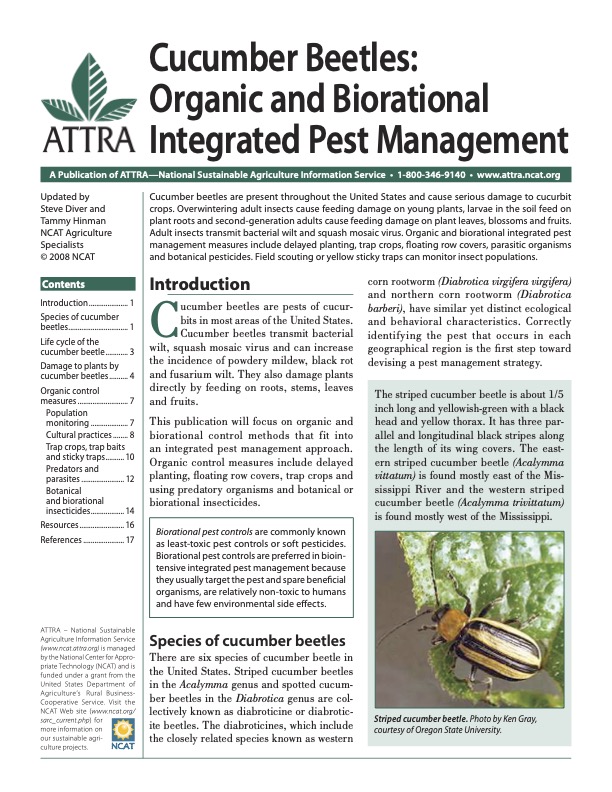
Cucumber beetles are present throughout the United States and cause serious damage to cucurbit crops. Overwintering adult insects cause feeding damage on young plants, larvae in the soil feed on plant roots and second-generation adults cause feeding damage on plant leaves, blossoms and fruits. Adult insects transmit bacterial wilt and squash mosaic virus. Organic and… Continue reading Cucumber Beetles: Organic and Biorational Integrated Pest Management
Flea Beetle: Organic Control Options
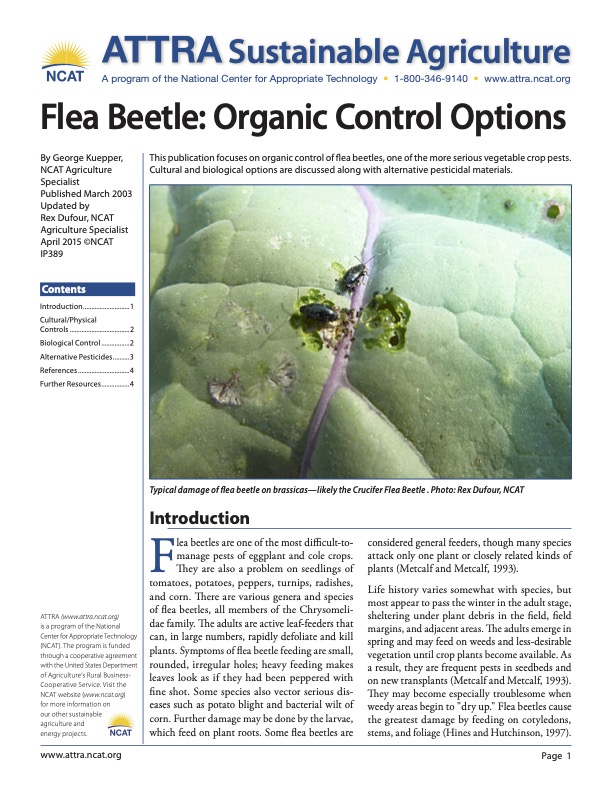
This publication focuses on organic control of flea beetles, one of the more serious vegetable crop pests. Cultural and biological options are discussed along with alternative pesticidal materials.
Organic IPM Field Guide
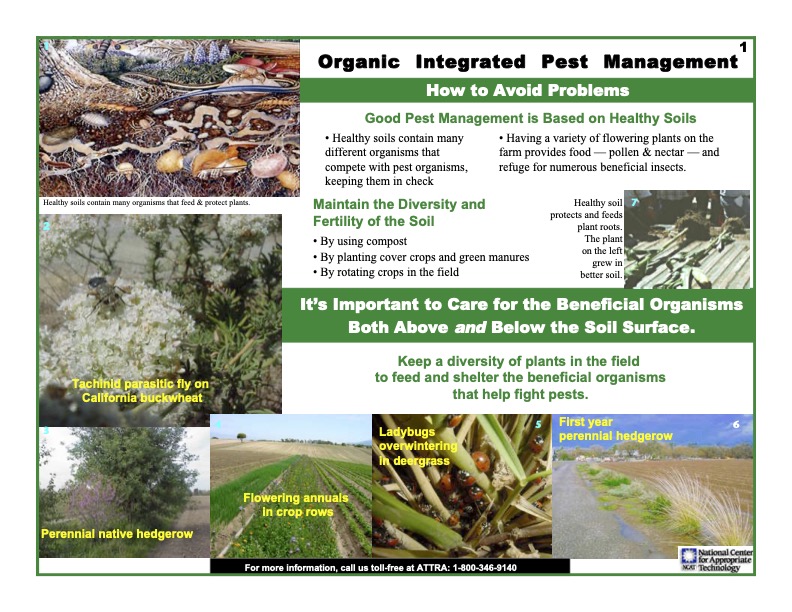
The idea behind this field guide was to provide a pictorial guide about the concepts of organic IPM and important pests and beneficials. The focus of the document is implementing ecologically-based strategies to prevent pests from becoming a problem in the first place. ATTRA attempted to limit the text to provide only useful take-home’ messages… Continue reading Organic IPM Field Guide
Squash Bug and Squash Vine Borer: Organic Controls
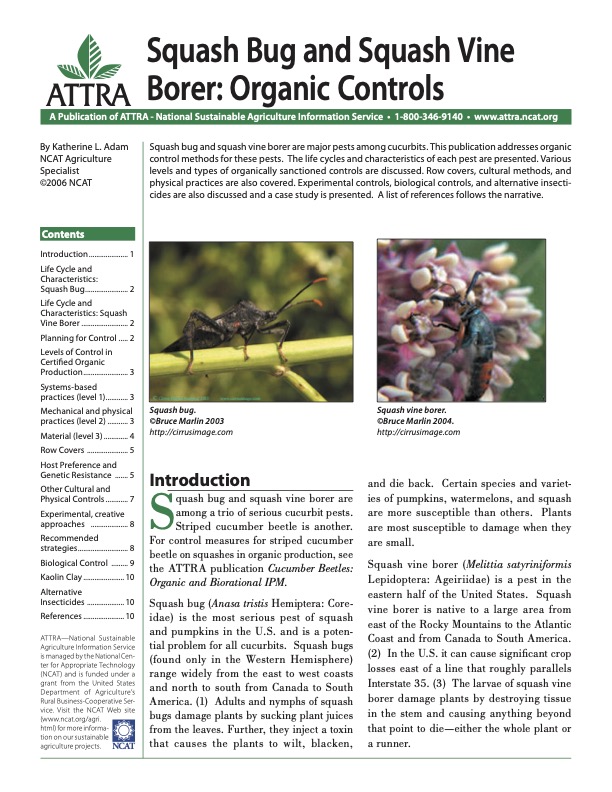
Squash bug and squash vine borer are major pests among cucurbits. This publication addresses organic control methods for these pests. The life cycles and characteristics of each pest are presented. Various levels and types of organically sanctioned controls are discussed. Row covers, cultural methods, and physical practices are also covered. Experimental controls, biological controls, and… Continue reading Squash Bug and Squash Vine Borer: Organic Controls
Sustainable Weed Management for Small and Medium-Scale Farms
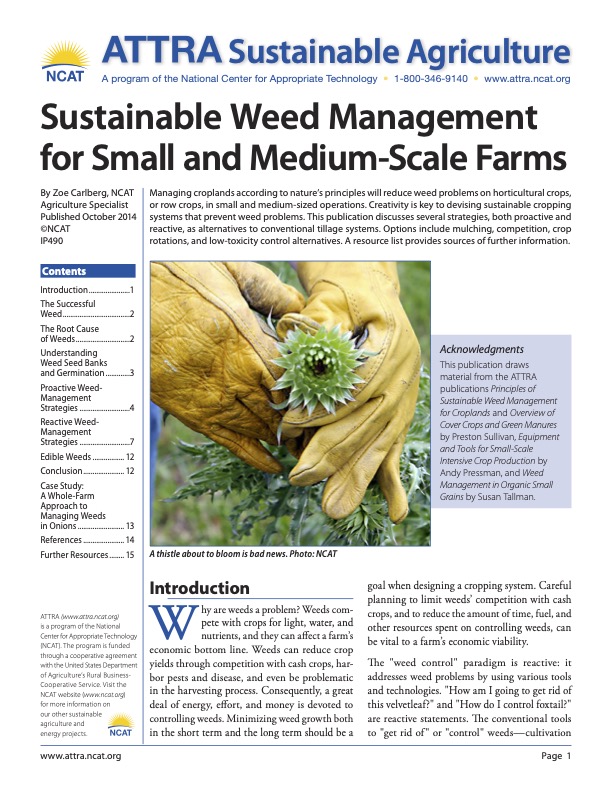
Managing croplands according to nature’s principles will reduce weed problems on horticultural crops, or row crops, in small and medium-sized operations. Creativity is key to devising sustainable cropping systems that prevent weed problems. This publication discusses several strategies, both proactive and reactive, as alternatives to conventional tillage systems. Options include mulching, competition, crop rotations, and… Continue reading Sustainable Weed Management for Small and Medium-Scale Farms
NOP 5020 Guidance on Natural Resources and Biodiversity Conservation
USDA’s National Organic Program guidance on biodiveristy and conservation for organic production and certification.
An Organic Farmer’s and Certifier’s Guide to Biodiversity Conservation
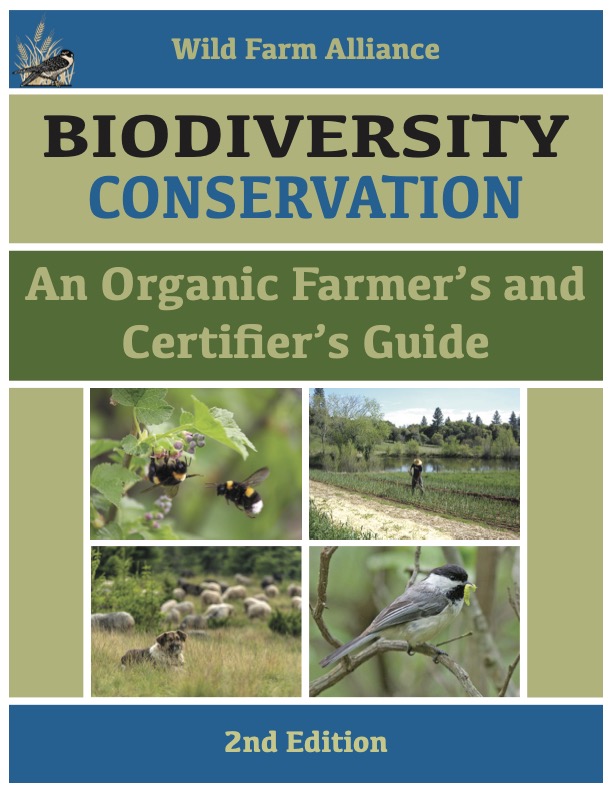
The Guide clarifies the National Organic Program’s (NOP) new Natural Resources and Biodiversity Conservation Guidance (released January 2016). The Guide will also increase organic farmers’ and certifiers’ understanding of the myriad of benefits provided by biodiversity conservation.
Audit Trail: A Sample Documentation Process
One of the core practices of your certified organic operation is developing good quality record-keeping and documentation (commonly referred to as an “audit trail”). Use this tool as an example when developing the documentation process for your operation.