This publication discusses various marketing channels for organic herbs and assesses the economic factors to consider for small-scale organic greenhouse production of fresh-cut herbs. It also addresses production methods, including potential for hydroponic production.
Type: Manuals/Guides
Apples: Organic Production Guide
This publication provides information on organic apple production from recent research and producer experience. Many aspects of apple production are the same whether the grower uses low-spray, organic, or conventional management. Accordingly, this publication focuses on the aspects that differ from nonorganic practices-primarily pest and disease control, marketing, and economics.
Organic Labeling and Composition Guide
This document discusses the labeling requirements of the standards to which we certify. Covered are all certification categories from a bulk labeled single ingredient product to complicated multi-ingredient processed product.
Mentor Training Activity Workbook
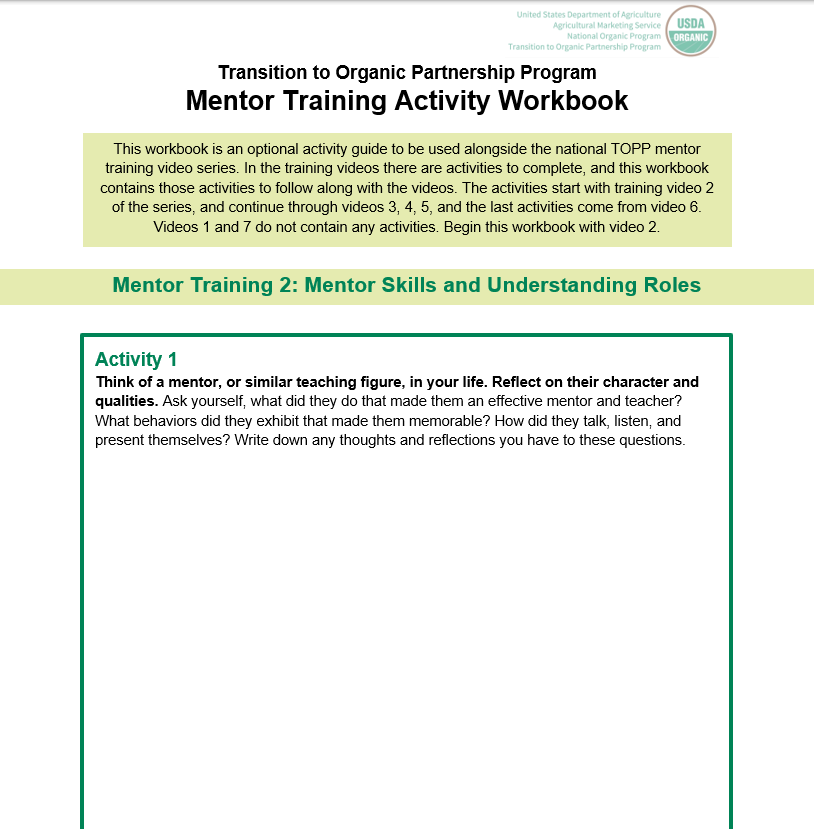
Mentor training activity workbook to be used alongside the mentor training video series. This workbook contains all the activities that are included in the mentor training series, videos 2 – 5. Use this PDF version for printing.
Mentor Training Activity Workbook
Mentor training activity workbook to be used alongside the mentor training video series. This workbook contains all the activities that are included in the mentor training series, videos 2 – 5. Use this Word document to download and keep notes.
Increase the Sustainability of Your Business
Need a quick reference guide for how to get started with increasing the sustainability of your organic business? Oregon Tilth’s condensed Quick Start Guide series is designed to answer your big questions quickly, give examples and point to helpful tools to get started
Allowed Detergents and Sanitizers for Food Contact Surfaces and Equipment in Organic Operations
The National Organic Program’s (NOP) Organic Standards require that an organic handling operation take measures to prevent the commingling of organic and nonorganic products and protect organic products from contact with prohibited substances. (USDA organic regulations 7 CFR 205.272). Cleaning and sanitizing is an important part of an organic system plan. The purpose of this… Continue reading Allowed Detergents and Sanitizers for Food Contact Surfaces and Equipment in Organic Operations
Quick Start Guide: Formulating Multiple Ingredient Products
Need a quick reference guide for how-to get started with tracking ingredients, sourcing materials and making sure your following USDA NOP regulations for certification? Oregon Tilth’s condensed Quick Start Guide series is designed to answer your big questions quickly, give examples and point to helpful tools to get started
Quick Start Guide: Transition Your Farm Operation to Organic
Need a quick reference guide for how to get started with transitioning to organic? Oregon Tilth’s condensed Quick Start Guide series is designed to answer your big questions quickly, give examples, and point to helpful tools to get started.
National Organic Farming Handbook
The USDA National Organic Farming Handbook